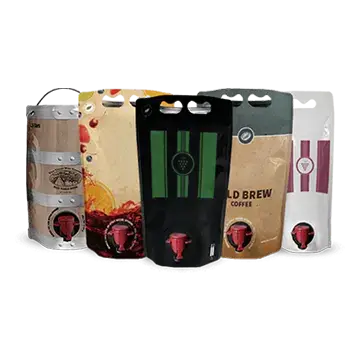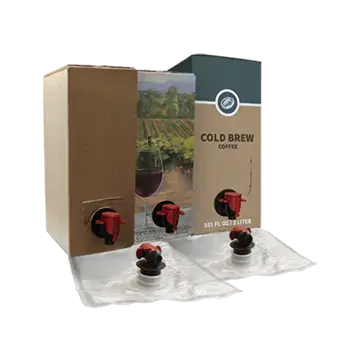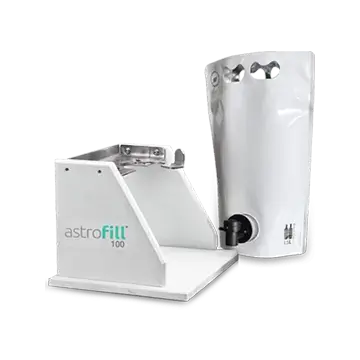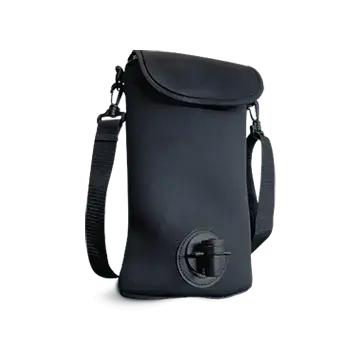


For beverage brands, packaging is one of the few line items where a single decision can move the needle on margins, freight bills, and warehouse space all at once. As raw material costs and shipping rates keep climbing, more brands are re-evaluating whether traditional glass bottles are still the right fit for wine, spirits, cold brew, and other liquid categories.
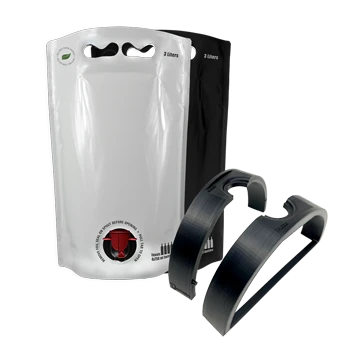
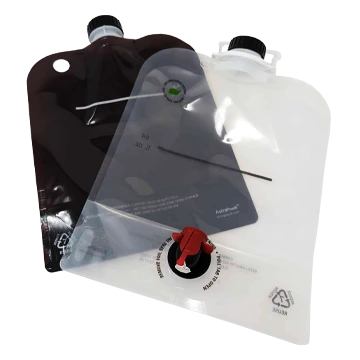
That is driving a broader shift toward beverage packaging solutions built around flexibility rather than rigidity — namely, liquid pouches. The real question for most brands is not whether pouches can save money, but how much, and where those savings actually come from.
Why Cost Efficiency is at the Center of the Packaging Conversation
As we’ve previously outlined in Why Liquid Pouch Packaging Beats Traditional Bottles, the cost efficiency and logistics advantages of pouches come down to three factors:
- Less raw material per unit
- Lighter and more compact shipments
- Better use of warehouse space
Those advantages sound good in theory, but brands evaluating a packaging change need real numbers, not generalities. Below is an example of exactly what that comparison may look like, using a direct cost breakdown of 750mL glass bottles versus 1.5L pouches.
Real-World Comparison: 750mL Glass Bottles vs. 1.5L Pouches
To make an apples-to-apples comparison, the analysis is based on equivalent volume: two 750mL bottles hold the same liquid as one 1.5L pouch. So the fairest way to compare costs is per 9-liter case equivalent — 12 bottles on one side, six 1.5L pouches on the other. This is the same equivalent-volume methodology used across the industry when comparing rigid and flexible formats, since it accounts for differences in container size rather than comparing unit-to-unit.
Here is how the direct packaging material costs break down:
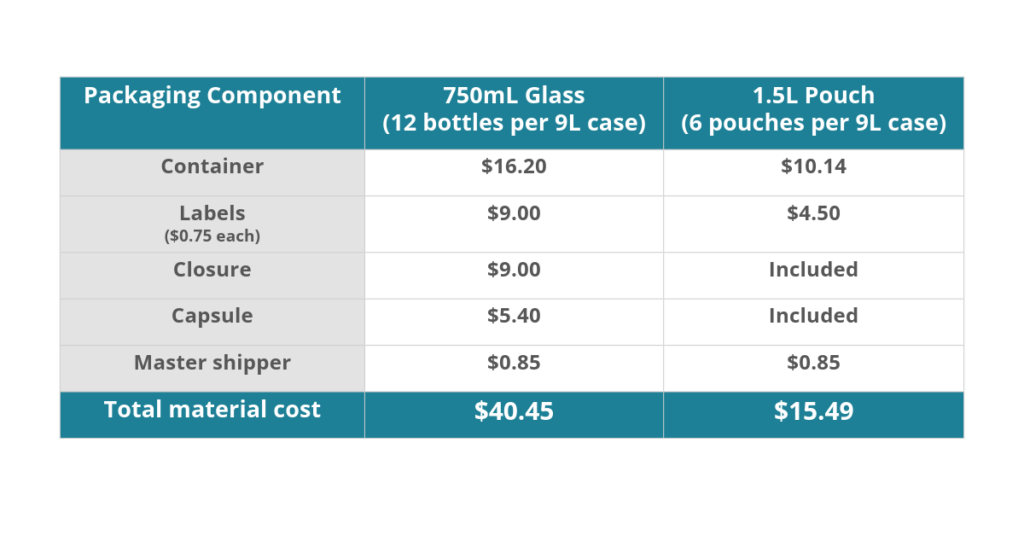
The Result: Switching from 750mL glass bottles to 1.5L pouches cuts direct packaging material costs by $24.96 per 9-liter case equivalent — that’s a 61.7% reduction, well above the 30% minimum savings brands can typically expect from making a packaging switch. Notice that the closure and capsule line items disappear entirely on the pouch side, since the dispensing fitment is already built into the pouch itself.
What the Savings Look Like at Volume
Numbers per case are useful, but production runs make the impact clearer. Consider a run of 250 9-liter case equivalents — 3,000 750mL bottles on the glass side, or 1500 1.5L pouches on the other:
- Glass packaging cost: 250 cases × $40.45 = $10,112.50
- Pouch packaging cost: 250 cases × $15.49 = $3,872.50
- Total savings for 250 cases: $6,240.00
That’s over $6,000 in material savings on a single mid-sized run — before freight or warehousing costs are even factored in.
Real-World Comparison: 750mL Glass Bottles vs. 750mL Pouches
Now, let’s say that you’d prefer to keep your product packaging at 750mL, what would the cost savings look like for a more apples-to-apples comparison?
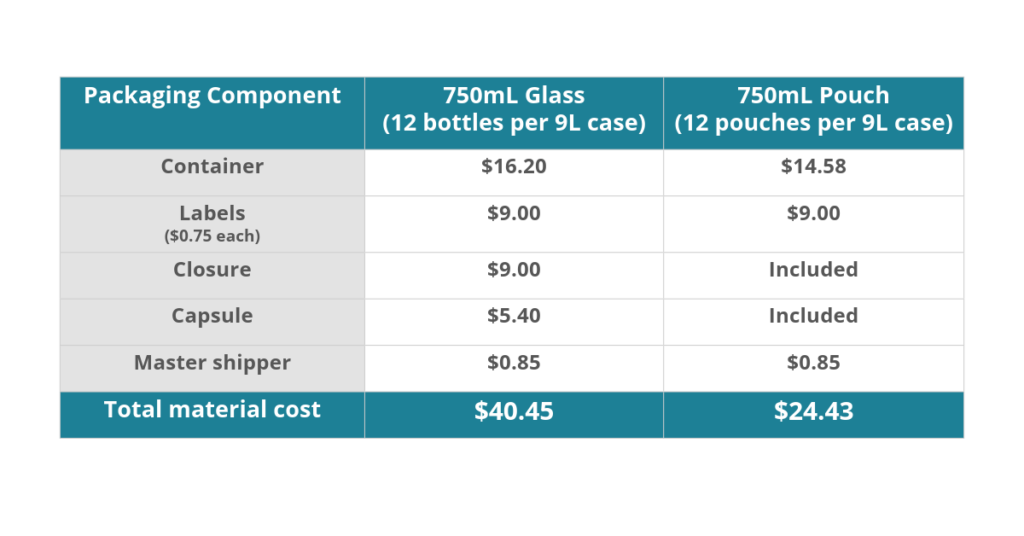
In this example, you would save $16.02 per 9L case – that’s a 38.9% reduction in material costs. At volume, your total cost savings for 250 cases would be $4,005.
Freight and Storage Add Even More to the Savings
Material costs are only part of the picture. Because pouches are lightweight and compact, brands can ship more finished products per pallet and per truckload, which reduces freight costs directly. The same logic applies in the warehouse: pouches make better use of vertical and horizontal space than rigid bottles, and unfilled pouches can be stored flat, shrinking the footprint needed for inventory. For manufacturers and co-packers running high volumes, those logistics savings often compound the direct material savings shown above, making the total cost impact even larger than the packaging-only numbers suggest.
Choosing Beverage Packaging Solutions That Fit Your Brand
A 61% reduction in direct packaging costs is a compelling number, but the right beverage packaging solution still depends on your product, your filling process, and your existing infrastructure. Brands moving from bottles to pouches should evaluate film and barrier requirements, fitment and dispensing options, and a partner’s ability to scale from pilot runs to full production.
Working with an experienced partner like AstraPouch can help you translate savings like these into a packaging format that fits your brand, without sacrificing shelf life or product quality. For a deeper look at how pouches compare to bottles across sustainability, branding, and consumer experience, check out Why Liquid Pouch Packaging Beats Traditional Bottles.
The bottom line is that the case for switching is no longer theoretical. When the direct material savings, freight efficiencies, and warehouse gains are added together, beverage packaging solutions built around liquid pouch packaging give brands a credible path to protecting margins without cutting corners on quality or consumer experience.